SAFe® Transformation
Start from an operational implementation of SAFe® as a Lean-QMS and turn it into your defined way of working for your organization.
Explore this use caseFor organizations introducing or evolving SAFe®, an operating-model platform to move faster from framework to fitted process, keep compliance aligned in one Lean-QMS, and prove how people and AI agents actually work.






“We are pleased to be working with such outstanding innovators as PEDCO’s Peter Pedross and his team. The potential to help ease the way for fully comprehensive SAFe® adoption is enormous.”
“Applied SAFe® is a very valuable tool for an agile transition project in a regulated environment. You need less time and less investment in work to be able to implement a complete agile standard process with Applied SAFe®.”
“In Aerospace you can imagine that it’s difficult to establish an agile transformation process in the long run. With Applied SAFe®, we have been able to define the needed processes for our organization in a very short time. We combined the ‘new way of working’ with our existing knowledge; in a compliant and efficient manner.”
“With Applied SAFe® medical device companies can not only prove that the development of complex physical products using SAFe® still meets all regulatory requirements but also have a very performant tool to support a sustainable SAFe® implementation.”
“The way Applied SAFe® highlights the configuration possibilities of the SAFe® framework and makes roles, responsibilities, and processes very clear, without doubt, it saves a lot of time. Not to mention the superb support in regards to mapping to reference models from regulated environments to help ensure process compliance.”
“Regulatory environments discouraged many companies from the manufacturing industries to start an agile transformation process. With Applied SAFe® these companies can not only prove that the development of complex physical products using SAFe® still meets all regulatory requirements.”
“PEDCO has put many man-years of experience in the Applied SAFe Process framework and the approach to introduce this in an organization. This partnership will shorten the introduction of process and tools, so engineers can concentrate on creating value.”
“We truly understand the challenges faced by our clients when implementing SAFe, particularly for those operating in regulated industries. With PEDCO’s Applied SAFe, the potential to smooth the path to a full SAFe adoption that ultimately translates to high business value and customer delight is substantial.”
Start from a proven Applied SAFe® baseline while AI reconciles your context, standards and existing way of working. Spend less time in workshops and manual interpretation, and less expert effort getting the operating model right.
Governed tailoring, inheritance and impact analysis let you adapt processes to your organization while maintaining traceability to SAFe®, standards and compliance requirements. The same operating model gives AI agents the right context, rules and controls, so every variant stays connected as frameworks, endeavours and agentic workflows evolve.
Continuously connect obligations, process, execution and evidence in one Lean-QMS, across teams and AI agents. Surface deviations earlier and maintain a defensible record of how work was supposed to happen — and how it actually did.
Start from an operational implementation of SAFe® as a Lean-QMS and turn it into your defined way of working for your organization.
Explore this use caseBring engineering, quality, safety, and company-specific know-how into your SAFe® operating model without starting over.
Explore this use caseFind where your SAFe® transformation is gaining traction, where it is meeting resistance, and why — through surveys and AI voice interviews across the organization.
Explore this use caseKeep the SAFe® operating model connected to the standards and evidence your products must satisfy.
Explore this use caseGive engineering agents the process context, rules, authority boundaries, and human checkpoints they need to operate safely.
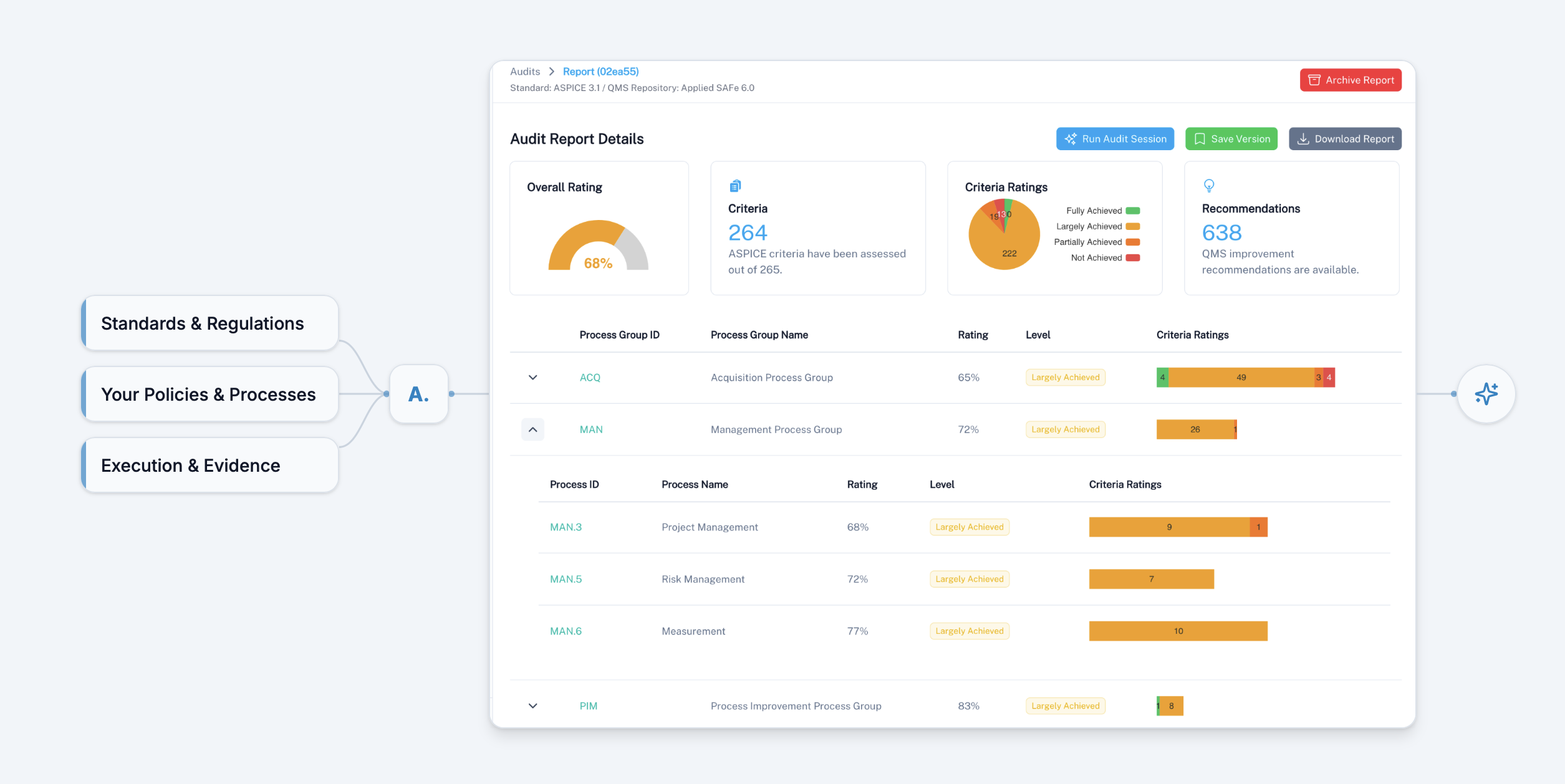
Explore this use caseRun evidence-backed internal assessments before the external auditor arrives — across processes, evidence, and the people performing the work.
Explore this use caseBegin with a maintained, executable Applied SAFe® baseline, then adapt it to your organization, existing practices, and each context. AI-assisted customization and tailoring help you get to the right process without rebuilding SAFe® from scratch.
Map applicable standards, regulations, and internal policies directly to your processes. Make requirements part of the way work is defined and performed, with clear traceability from every requirement to the relevant process elements. AI-assisted recommendations help you strengthen coverage and evolve your processes as requirements change.
Give people and AI agents the process guidance and controls that apply in context, then verify whether execution and evidence match the defined process. Surface deviations early and keep the link from obligation to process to execution.
Built on years of real-world Applied SAFe® implementations across complex organizations.
Most alternatives answer only part of the problem. Applied SAFe® connects process definition, tailoring, execution guidance, compliance assurance, and improvement in one governed operating model.
The result is one operating model that stays usable, provable, and current as the organization evolves.
What the platform does, what it does not do, and where accountability stays with your organization.
Applied SAFe® Platform is a platform and expertise solution, not just a per-user tool. The Applied SAFe® content is licensed per user, and your investment also covers platform access, ready-to-use AI capabilities, and access to experts through the PEDCO Applied SAFe® partner network. Our team will scope the right engagement with you in the first conversations.
No. Start from the maintained Applied SAFe® baseline, customize with the practices and process elements you already use, reuse what fits, and customize what needs to change.
No. The platform helps determine what applies to each organization, product, ART, project, and team, then manages those choices as governed variants instead of uncontrolled local interpretations.
The platform brings SAFe®, standards, regulations, internal policies, and your organizational context together, then maps applicable requirements to the operating model and highlights gaps or conflicts.
No. It helps you build conformance into the process, identify gaps, recommend changes, and continuously connect obligations to process, execution, and evidence; approval and formal compliance accountability remain with your organization and assessors.
It can be. Applied SAFe® is SAFe® implemented as a Lean-QMS: one model that carries the processes, roles, work products and tailoring rules, the standards mapped onto them, and the evidence read back from execution. Whether it satisfies a particular certification scope remains your organization's and your assessor's determination.
ChatGPT and general copilots answer prompts. Applied SAFe® Platform works on a structured, governed operating model: it understands your tailored SAFe® context, standards, process relationships, evidence, and decision boundaries so AI can help engineer, execute, and verify the process without inventing its own rules. See what the alternatives cover.
No. The operating model can be delivered into the tools people already use, so contextual process guidance sits closer to the work instead of becoming another isolated process portal.
You can choose data-sovereignty options so data is stored in specific regions based on your requirements and local compliance needs. We use cloud providers that meet ISO security standards, and data is stored and processed securely throughout.
Impact analysis shows which mappings, process elements, variants, teams, and evidence obligations are affected, so approved changes can be propagated consistently instead of triggering another manual update exercise.
AI proposes within a structured operating model, deterministic rules verify where possible, and humans govern what is approved and published. The goal is governed process engineering, not an unconstrained chatbot.
The same governed operating model can be compiled into explicit Skills, Rules & Hooks for agents, including actor eligibility, authorization boundaries, and mandatory human checkpoints.
No. SAFe® is the framework; Applied SAFe® Platform is how your organization turns it into the way it actually works. The platform starts from a complete, maintained implementation of SAFe® and adds the system for customizing, tailoring, instantiating, governing and improving it.
Customization changes or extends the process model itself: adding an activity, modifying a role, integrating a company-specific process. Tailoring selects which of the already modelled elements apply in a specific context, through predefined tailoring questions. Customize the model; tailor the applicability.
It contains one, but that is not what you buy. A modelling tool gives you a blank canvas and a notation. Applied SAFe® Platform gives you a complete, expert-authored implementation of SAFe® with built-in tailoring logic — and the governance, inheritance and verification that keep it current. See what the alternatives cover.
No. The platform owns the operating model; it does not try to own the work. Guidance is delivered to the surfaces people already use, and execution stays in your engineering toolchain.
Those systems answer different questions — where guidance is consumed, and what work is being executed. Applied SAFe® Platform answers what the operating model is and what applies here. It delivers the effective process into those surfaces, and reads execution and evidence back from them.
AI proposes. Deterministic rules verify. You govern. AI understands organizational context, proposes customizations, recommends tailoring choices from predefined options, analyses framework and standards changes, and compares the intended process with actual execution. It never approves its own work.
The Applied SAFe® baseline is maintained as SAFe® evolves. Because your customizations are modelled as a distinct layer over that baseline rather than edits to a copy, the impact of a framework change on your organization can be analysed before it is adopted.
See the operating model on your own context in a product walkthrough.